Digitalized Manuscripts

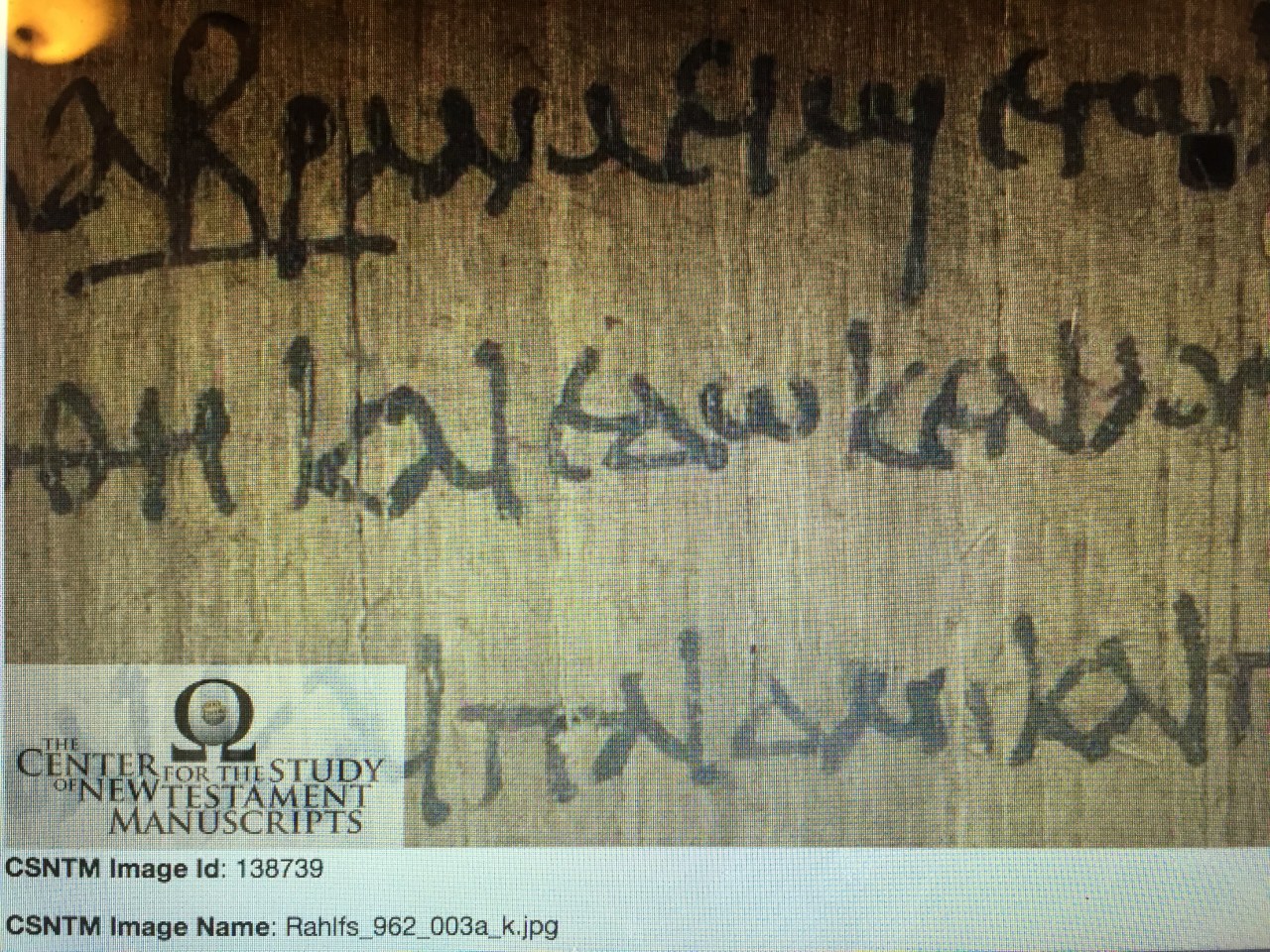
The New Center for the Study of New Testament Manuscripts

Since they began their work in 2002, a core part of their mission has been to make it possible to view and study New Testament manuscripts from anywhere in the world. They have worked toward this by traveling around the globe and capturing beautiful digital images of some of the most important extant manuscripts.

Today, they are taking another step forward by making it easier than ever for us to access manuscripts.

They’re launching the new CSNTM.org.

Here are some of the features that we can expect to find now and in the coming weeks:

  • New Manuscripts – They will be adding 10-20 new manuscripts to their website weekly for the next few months. These will be from the National Library of Greece in Athens (their ongoing project for 2015–16), as well as previously unposted images from hundreds of manuscripts and rare books in their collection.
  • New Look – They have revamped their entire website to make it both simpler and richer in content. They have new content, which narrates how they go about digitizing and archiving manuscripts. They also explain what goes into their extensive training program that enables their teams to work quickly while capturing high-quality images.
  • New Viewing Environment – The website is equipped with a new viewer, which makes it easier than ever to navigate manuscripts and view their stunning new images.
  • New Usability – Their new site is also designed to work perfectly with mobile devices and tablets, enabling us to view manuscripts or to access other resources quickly, whenever we need them.
  • New Search Features – The website is now outfitted with an extensive search functionality. Searches can be performed at the manuscript level, allowing us to find manuscripts that meet certain criteria (e.g., date, contents, material, location). They can also be performed at the image level, which allows us to find specific features within a manuscript. For instance, they now have a Jump to Book option that allows us to find the beginning of each book that a manuscript contains. Also, one can search tagged manuscripts for verse references. Every place, for example, in which John 1.1 is tagged will automatically populate when the verse is searched.
  • New Search Database – The search database holds tags for each manuscript and individual image. As their team continues tagging their growing collection, the search function will become more comprehensive each week. But the task is daunting. They want our help for the tagging!

If interested, you can reach them via their contact page:

http://www.csntm.org/

Please share their new site with colleagues and friends, so more and more people can continue to utilize CSNTM’s library, which is free for all and free for all time. They sincerely hope that you enjoy using the site. It represents a giant leap forward in accomplishing their mission: to bring ancient New Testament manuscripts to a modern world.


SO WHAT?

Look, I don’t read Greek.  It gives me confidence, however,  to know that scholars – Christian and non-Christians – who actually do read and do understand the Greek language have dedicated their whole lives to make sure that the thousands of manuscripts we have in our possession say pretty much the same thing.

It gives me confidence to know that the deity of Christ was NOT invented at the Council of Nicea, or that  – other than errors in spelling – the cardinal doctrines of Christianity have always been the same. Paul did not make them up. Nobody corrupted the manuscripts. We can prove it – because we kept them all 🙂

You might like to watch an interview with Daniel Wallace, who is the Executive Director for the NCSNTM. He speaks his mind into the New Testament (NT) tradition. The 5, 839 Greek NT manuscripts, plus the up to 20, 000 NT manuscripts in other ancient languages, plus the over a million NT quotations from the early Church Fathers definitely DO NOT help the Muslim conspiracy theory of Bible Corruption. We can zero in very, very well what the original text said. For the interview click here.

And since David Wood is one of my heroes, we also have his interview with Dr. Michael Licona about the Historical Jesus vs. the Muslim Jesus. To watch that interview, click here.

And last, but not least, an interview with Gary Habermas. During the last ten years, Dr. Habermas has dedicated all his efforts to update his bibliography on the major scholarly research on Resurrection (from 1975 to the present) in French, German and English – if you don’t mind. You can see the interview here.

Hope this helps 🙂

New Testament Contradictions

I have watched many debates and talks that discuss the New Testament  alleged contradictions. This has been a topic that grabbed my special interest ever since I was living in India. The reliability of the text of the New Testament is something that is particularly attacked in the Muslim world.

I hope Dr. Licona’s lecture on Bible Contradictions will help people realize that the contradictions are not really so. Also, you might want to watch some of Dr. Licona’s debates with Barth Erhman regarding the Resurrection of Jesus. You can easily find those on YouTube.

If you ever decide to give Dr. Erhman a chance to mess with your mind, I can assure you he will. I have come to appreciate him – only by watching his debates – and he seems like a nice, funny guy. Bart Erhman has made a living by writing books that create doubt in the minds of Christians. But that is all there is. He is good at casting doubt, but he kinda has a double standard.

In one of his famous books Misquoting Jesus, Erhman concludes that you cannot really trust the manuscripts, and therefore, you cannot really know what the original manuscripts of the New Testament said. However, in the same year when he wrote Misquoting Jesus (2005), he also cowrote an academic book called The Text of the New Testament with Bruce Metzger – the greatest manuscript scholar of the last century.

In The Text of the New Testament, Metzger and Erhman conclude that the manuscripts of the New Testament have been accurately copied, and that we know what the original ones said. So when Erhman writes for a lay audience, he says you cannot trust the manuscripts. But when he writes for an academic audience, Erhman says you can actually trust them.

Why would a respected scholar do this? Same year, same texts, but two different conclusions. I think Erhman knows he cannot get away with these conclusions within an audience that knows what he is talking about. But he can get away with it with the popular audience. And these books that cast doubt into the Bible text – unfortunately – are very popular and sell a lot of copies.

Actually, many Muslims adore Erhman because he is a former Christian who is now a critic of the New Testament. Muslims often exploit Ehrman’s work and parade his anti-Christian rhetoric in videos and articles.  It is important to note, tough, that Erhman, along with the majority of serious scholarship, holds the view that Paul was a true disciple of Jesus Christ who met with the leaders of the early church shortly after Jesus’ crucifixion – not a usurper.

Also, Dr. Ehrman remarks that we can say with confidence that Jesus actually did die, he probably was buried, and that some of his disciples (all of them or some of them?) claimed to have seen Him alive afterward. Erhman also says that NO scribe EVER changed the cardinal doctrines of Christianity i.e. Council of Nicea (on the divinity of Christ).

Now that you have the background on who Dr. Bart Erhman is, you can enjoy the lecture 🙂


If you have doubts about the Christian faith, have you put those doubts *themselves* to the test as much as you have Christianity?

Andy Bannister


Are there contradictions in the Gospels?

The Tolerance Jesus will not tolerate

Great article by Kevin DeYoung from The Gospel Coalition.


Christians cannot be tolerant of all things because God is not tolerant of all things.

We can respect differing opinions and try to understand them, but we cannot give our unqualified, unconditional affirmation to every belief and behavior. Because God doesn’t. We must love what God loves. That’s where Ephesus failed. But we must also hate what God hates. That’s where Thyatira failed.

Of the seven cities in Revelation, Thyatira is the least well known, the least impressive, and the least important. And yet, the letter is the longest of the seven. There was a lot going on at this church–some bad, some good.

Let’s start with the good. Verse 19, “I know your deeds, your love and faith, your service and perseverance.” Ephesus was praised for its good deeds and strong work ethic. Thyatira is even better.  It has the deeds that Ephesus had and the love that Ephesus lacked. The church at Thyatira was not without genuine virtue. It was a tight-knit bunch who loved, served, believed, and endured.

Maybe Thyatira was the kind of church you walked into and immediately felt like you belonged: “Great to meet you. Come, let me introduce you to my friends.  Here, I’ll show you how you can get plugged in, use your gifts, do ministry. We’re so glad you’re here.” It was a caring church, a sacrificial church, a loving church.

That was the good part. And the bad part? Its love could be undiscerning and blindly affirming. The big problem at Thyatira was tolerance. The folks at Thyatira tolerated false teaching and immoral behavior, two things God is fiercely intolerant of. Jesus says, “You’re loving in many ways, but your tolerance is not love. It’s unfaithfulness.”

The specific sin in Thyatira was the tolerance of Jezebel. That wasn’t the woman’s real name. But this false prophetess was acting like a Jezebel-leading people into adultery and idolatry. We don’t know if her influence was formal–she got up in front of people and told them these deceptive things–or if it was informal–taking place in conversations and by word of mouth. However it was happening, this woman in Thyatira was a spiritual danger, like her Old Testament namesake.

Jezebel was the daughter of Ethbaal king of the Sidonians. She worshiped Baal and Asherah and led her husband, Ahab, in the same. Jezebel is the one who plotted to kill innocent Naboth for his vineyard. She was called “that cursed woman” (2 Kings 9:34). As a punishment for her wickedness, she was eventually pushed out a window, trampled by horses, and eaten up by dogs. She was a bad lady. And she lead many Israelites down a bad path.

Jesus says to Thyatira, “You are allowing a woman like that to have sway over your people. Why do you tolerate her? Don’t affirm her. Don’t dialogue with her. Don’t wait and see what happens. Get rid of her… or I will.” Apparently, by some means, the Lord had already warned her to repent, but she refused. And so now the Lord Jesus promises to throw her onto the sick bed and make her followers suffer as well, unless they repent. “I will strike your spiritual children dead,” says the Lord. Jesus isn’t messing around here. This isn’t a secondary issue. This is a serious sin worthy of death.

It was also an entrenched sin. There were a number of trade guilds in Thyatira. Suppose you belonged to the local BAT, the Bricklayers Association of Thyatira, and one night the guild got together for a feast. You’d be sitting around the table, ready to partake of this great celebration with your friends and colleagues, and the host would say something like, “We’re glad you could make it. What a happy occasion for the BAT. We have quite a feast prepared for you. But before we partake, we want to recognize the great god Zeus who watches over the bricklayers and has made this dinner possible. Zeus, you see his statue in the corner, we eat to you, in your honor, for your worship. Let’s dig in.”

What would you do in that situation? Stay or go? What would your participation signify before your fellow Christians, before the watching world, before God? Christians in the ancient world didn’t have to go searching for idolatry. It was woven into the fabric of their whole culture. To not participate in these pagan rituals was to stick out like a Yankees fan at Fenway Park. These feasts, with their idolatry and the sexual revelry which would often follow, were a normal part of life in the Greco-Roman world. To remove yourself from them could be socially and economically disastrous.

Which is why false teachers like this Jezebel in Thyatira or the Nicolaitans in Pergamum gained such a hearing. They made being a Christian a lot easier, much less costly, must less counter-cultural. But it was a compromised Christianity, and Jesus could not tolerate it. He was going to make an example of Thyatira to show all the churches that Jesus has eyes like fire, too pure to look on evil, and feet like burnished bronze, too holy to walk among wickedness. He wanted all the churches to know that he was the searcher of hearts and minds and he would repay evil for unrepentant evil.

The error of Jezebel was a serious sin, an entrenched sin, and a subtle sin. The people had probably been told that the “deep secrets” wouldn’t harm them. We don’t know exactly what it meant for the church to learn Satan’s so-called deep secrets. We don’t know if that’s what the false teachers called them or if that’s what Jesus is calling them. But what was going on was probably some kind of false teaching that devalued the material world.

This Jezebel may have been saying, “The physical world doesn’t matter. It’s the spiritual realm that counts. So go ahead and participate in idol feasts and do whatever you want sexually. Those are material things. God doesn’t care about that.” Or she may have been saying, “Look, if you are truly spiritual, then your relationship with God will be strong enough to withstand the deep things of Satan. So go ahead. Participate in evil practices. You can handle it and you’ll probably even learn more about the enemy in the process.”

Whatever it was that she was saying, it was a lie and it was leading people into sin.

The church was more tolerant than Jesus, which is never a good idea.


FAITH AND DOUBT – PART 3

Abdu Murray was Muslim – a very serious Muslim.  His story really impacted me last year. It impressed me that people were willing to go years looking for Truth. Why wouldn’t I do the same? It took Abdu nine years – nine years – to investigate the historical, philosophical, and scientific underpinnings of the major world religions and views. Abdu became Christian.

I was a Christian! Yet, here I was doubting. I have heard testimonies of people becoming Christians because the evidence for Christianity compelled them. What was that about? I just had to know. I was about to jump ship on Jesus. Being honest, I never had the conviction in my heart of Mohammad being a prophet. And all due respect to Islam, I don’t think there is anything new or anything kinder or gentler or more compassionate in Islam’s teachings than what I had already learned from Jesus.

If I almost left Christianity, it wasn’t because I thought Islam was true. I almost left Christianity because I didn’t know how to handle my doubts. Not knowing what the TRUTH was consumed me day and night.

In all equality, I also heard many testimonies of Christians becoming Muslims. You know what, tough? It was never the evidence for Islam what made these people accept Islam. They always left Christianity – at least the people I watched – because no one was able to answer their questions. They never understood The Trinity, or they were sick of the hypocrisy in the Christian world.

There are thousands of people who leave Islam and join Christianity and vice versa. I know the videos I watched are not representative of the whole picture. But for me, DOUBT was definitely important to deal with. I think it should be addressed when talking about Christian Faith.

If you are not a believer in anything, you deal with doubt all the time. But even Christians, we have doubts, too.  We doubt because of our circumstances, and I think that is a very human thing we do. God has answered my prayers many times. I have logs full of answered prayers. And last year in India, when I looked at them, I was almost cynical about it.

After eight years, I looked at those journals, and I doubted that those answers had actually come from God. Or maybe it had been God – but not Jesus. You have to understand where I am coming from. I was confronted with Islam on a regular basis, so almost all my doubts had to do with Jesus not answering my prayers. Or Jesus not being God. Or Jesus not claiming divinity. Or the New Testament being corrupted. Or Jesus not dying on the cross. I am talking Muslim-Christian apologetics.

So as I was listening to Rich Nathan’s series on Faith – Heroic Faith – I felt somehow able to breath. It was okay to have doubts. And I also heard Abdu’s podcast. Both were saying the same thing. They were talking about Richard Dawkins, and how blind faith is something Christians SHOULD NOT practice. They were also saying that Faith in something in the face of contradictory evidence, or even in the face of NO evidence at all, is absolutely UNBIBLICAL.

But the Faith encouraged in the Bible is the active action of TRUST based on evidence. We exercise this on a regular basis, we just don’t think about it anymore. We get on a car and we trust the brakes will work – because they have always worked. We trusted our lives on that car – because of previous evidence.

Cars don’t just explode on ignition and brakes don’t fail out of the blue. They might fail. Sure. Did I have CERTAINTY? No. I had Faith on that car because I have taken a ride for thousands of times, and it has never exploded. I trusted the evidence I had available.

WHAT IS DOUBT?

Doubt is NOT a dirty word. According to Murray, there are a lot of solid followers of Jesus who have doubts. Doubt is not a bad thing if it drives you to sincere search. In the Bible, Jesus never says not to question Him. Actually, Hebrews 11:6 teaches that God rewards those who earnestly seek Him. Jesus helped those who sincerely confessed their unbelief to Him. He never drew them away.

Murray encourages asking questions, and he sees that this is a challenge that the Church is facing. Some people have doubts, but they never ask questions mainly because doubt is often seen as a bad thing. When a teenager asks a question, Murray says, sometimes he doesn’t ask his parents. And it is not because the question doesn’t have an answer, but because of the parents’ unwillingness to be questioned about it. Or sometimes, the parents themselves do not know the answer.

Inquisitive minds sometimes cannot settle for “The Bible says it. I believe it, and that settles it for me”. So it was refreshing for me to know that asking the tough questions was perfectly fine.

My heart was set on really finding God so I had peace about it. Sincerity is proven by our willingness to be proven wrong.  I was well aware that The Gospel could be false, but it could also be true. Sincerity is determined by our willingness to go where the evidence points. I had to be willing to accept that to say that all religious traditions believe basically the same thing, or that to say that our differences don’t matter was insulting for those faiths and for me.

If I agreed to say that all paths lead ultimately to God, what I was really saying was that my choices don’t really matter. But real choice emerges only when the options have consequences. Faith in Jesus Christ as Lord and Savior is a choice.


I wish I had your faith. You seem to have a peace about you, a confidence regarding the future. You don’t worry the way I do about everything. I wish I had your faith. But I really struggle with faith. I have lots of doubts. I still have lots of questions about God or about Christianity…

What does Faith feel like?


I was so sure about many things, and then I wasn’t sure about anything. Rich Nathan, tough, continued in the series saying that most folks believe that Faith is something you either have or your don’t have.

But in Hebrews 11:23-28, we find that Faith is a choice. It is a decision regarding how we’re going to look at life based on the clues that God has given us. Again, Faith is based on the evidence. Moses chose to be mistreated. People saw things at a distance. Faith feels like a choice to see and not look away. Faith and Truth are more than a feeling.

So it is okay to doubt… I was happy about this. I seriously was. Doubting did not mean I did not have Faith. My Faith was based on the exercise of my will. My choice.

And I was in good company. Jesus’ followers where doubters all the way until the Resurrection. They didn’t even know who He really was. And that is something that skeptics seem to dislike about Jesus’ disciples. They render as shameful the fact that Jesus’ closest friends did not really understand Jesus’ purpose. For a historian, however, that is called Principle of Embarrassment. It is very likely that an event who might embarrass the author is true. So the eyewitnesses writing these gospels were very likely telling the truth.

John The Baptist was a doubter himself. When he was in jail, he sent his disciples to ask Jesus if He was the Messiah. John was thinking maybe he had the wrong guy. And this is John the Baptist. The one who was prophesied by Isaiah about making straight paths for the Lord. This is John, the one who leapt in his mother’s womb when Elizabeth found out that Mary was pregnant. This John is doubting whether or not Jesus is the Expected One.

And what did Jesus do? He NEVER calls John out on his doubts. Jesus actually heals more people right there in front of John’s disciples. He gives them more evidence so that they can go and tell John!


John the Baptist sent us to you to ask, ‘Are you the one who is to come, or should we expect someone else?’ In that hour He [Jesus] healed many people of diseases and plagues and evil spirits, and on many who were blind he bestowed sight. And He [Jesus] answered them, ‘Go and tell John what you have seen and heard: the blind receive their sight, the lame walk, lepers are cleansed, and the deaf hear, the dead are raised up, the poor have good news preached to them. And blessed is the one who is not offended by me.

Luke 7:21-23


That was Jesus’ gentle answer. He eased John’s doubts.

Every one of us has different doubts. When we ask God with a sincere heart, He will always guide us. So as followers of Jesus, we deal with doubt by asking sincere questions. But the attitude in our hearts when we ask those questions is also very important.

Why are we asking? Do we really want answers or are we asking just for kicks? Last year, there came a time when I was just so used to question Islam and Christianity that I kind of became a cynic. I began questioning just for the sake of questioning. I was praying, and my prayers were being answered during my season of doubting.

But as soon as my prayers were answered, I kept on questioning whether or not it had only been a coincidence. I was almost demanding God to perform for me. I knew I had to stop. I repented from my cynical approach, and I made a choice based on the evidence I had recollected for and against Christianity during my year in India.

My Faith is stronger. My Faith is very well placed. I am so thankful that my God never let go of me during those difficult times. I am thankful for my Savior who died for me. I am thankful that the information was available to me because it helped me recommit my life to Christ. I want to make the information available to people who might need it 🙂


Who is the King of the Jungle? Who is the King of the Sea? Who is the King of the Planets? J-E-S-U-S!

– My sweet daughter


Sources:

FAITH AND DOUBT – PART 2

So Faith is attacked when The New Atheists uniformly say, “We base our lives on reason. You Christians base your lives on blind faith”.

But if reason is the authority when it comes to belief, and you can rely on reason because your own reasoning tells you – then you’re busted. It’s a totally circular argument. Unless you have something outside of reason to calibrate reason, you don’t know if your reasoning is accurate.

I think of this often when I watch debates. We, Christians, say Jesus died for our sins by crucifixion. Three days later He rose from the dead. Why do we believe that? Well, because the Bible says so is definitely one answer, but that answer won’t satisfy everybody. It will definitely not be enough for a Muslim, for example. Quran 4:157 says nobody kill Jesus nor they crucify Him. But God raised Jesus up to Himself.

When I began reading the Quran, my Bible stopped being the only source for my ‘reasoning’ – if that makes sense. Last year I found out that apart from the Bible, there are a lot of ancient non-biblical sources that talk about the crucifixion of Jesus as an event in history. When I evaluated the evidence that Islam has for Jesus not dying by crucifixion, I was confronted with many theories about it.

I read about different interpretations of that particular Quran ayat (verse). One interpretation is that God made Judas, the disciple who betrayed Jesus, look exactly like Jesus. So it was Judas who died. Another version is that the person who was crucified was not Jesus, but someone who bore His likeness, whom the Jews and the Romans had disgracefully put on the cross, while Jesus was standing nearby and laughing at their folly.

Yet another version is that the one who was nailed to the cross was Jesus, but He did not die on the cross, and was alive when He was taken down from it. They even argue Jesus might have died a natural death years later. But the theories (in Muslim Apologetics) go as far as they can go – as long as they have Jesus NOT dying on the cross.

But the more debates I watched, the more I knew that the position of the Muslim apologists was to say “We really do not have any further details, except that Quran tells us that Jesus was not the one who was crucified, but somebody that looked like Him”. 

I respect that. Absolutely I do. But I made the personal decision to go with the ancient historical evidence and not the theories. So I was able to calibrate the Bible with something outside of the Bible – call them Tacitus, Josephus, The Jewish Talmud. These accounts were not bad, given this information was coming from ancient accounts hostile to the Biblical record.

I realized that the Christian Faith is not that blind. Actually, it is not blind AT ALL.

Faith is a very important word in the New Testament. It is used over 24 times. Faith is so important that it is a prerequisite for being saved by God. On one occasion, a jailer asked Paul and his traveling companion, Silas, “What must I do to be saved?”  They replied, “Believe in the Lord Jesus, and you will be saved—you and your household.”

Hebrews 11:6 tells us that without Faith it is impossible to please God.


Now faith is the assurance of things hoped for, the conviction of things not seen. For by it the people of old received their commendation. By faith we understand that the universe was created by the word of God, so that what is seen was not made out of things that are visible.

Hebrews 11:1-3


We can see several things in this passage.

FAITH IS RATIONAL. Biblical Faith is never set against reason. Biblical Faith – Christian Faith – involves thinking. It involves our brains. Christian Faith is never a leap in the dark. The Greek word for Conviction is Elenchos. It means proof. It’a a conviction that comes when something has been tested.


Faith is trusting what we have good reason to believe is true.

Faith is trusting the evidence of the One who promised.


Faith is the evidence of things not seen. Evidence that appeals to your mind. Take any fact of history. Sure, you can’t prove in a lab that the American Revolution took place, or that the Declaration of Independence was signed on July 4th, 1776, or that George Washington was there when the Declaration of Independence was signed.

We believe this based on historical evidence – eyewitness testimony, records that were kept, historical investigations. There are lots of things that we reasonably believe that can’t be proven by the scientific method. But just because we cannot recreate them in a lab does not mean they never actually happened.

Was I there to see how Jesus died? No. Was I there to witness the Holocaust? No. But I believe the Holocaust happened because there are documents that were written about it. People preserved these records of history. I guess I can ALWAYS questioned whether the Holocaust took place because I wasn’t there to see it with my own eyes, but it is very likely that it happened. The same goes with the crucifixion of Jesus. And if you study the Resurrection – your mind will be blown away.

You can always find a counter-argument against Christianity. That’s for sure. You need to know, tough, that Christian Faith does not mean you have to be completely certain about something. Jesus tells us that even a little bit of Faith can go a long way. Faith IS NOT an all or nothing proposition.

I was so happy when I learned this.

FAITH GRABS HOLD OF THE FUTURE. Faith is the assurance – Hupostasis – of things hoped for. Faith gives substance to things. Faith reaches into the future Kingdom of God where life will be like when there are no wills contrary to God’s will – no human wills rowing in the opposite direction. Right now we rebel, and we want things contrary to what God wants for us. There are also demonic wills working in this present world.

But when the Kingdom of God is finally established on Earth, no child will ever die again. There will be no more cancer, no more heart disease, no more heartbreak, no more Alzheimer’s, no more diabetes, no more murders, or kids in jail, or funerals, or wars, or mental illness, or addiction. No more tears, no more crying, no more pain. God Himself will wipe your tears away. That is the hope given in Revelation 21:4 for all the children of God by adoption through our Lord and Savior Jesus Christ.

So Faith gives substance to that future Kingdom and makes it real now. By Faith we bring God’s Kingdom of justice into this world now – as we work for justice. By Faith we grab hold of God’s future Kingdom of healing into the world  – as we pray for the sick. By Faith, we grab hold of God’s future Kingdom of forgiveness and we make it real now – as we forgive others and ask for forgiveness.

FAITH IS A WAY OF SEEING THE PRESENT. Faith is seeing life the way Jesus saw it. People say that Christian Faith is looking at life through rose-colored lenses. But Scripture says quite the opposite. Faith is taking off your rose-colored lenses. All the myths and lies that the marketing machine of this world keeps pumping out – “You can have it your way” or “Life is all about you and your desires – your wants”.

Jesus was the only clear-sighted person in all of human history. He is the only one who saw with perfect vision how to live a completely full life no matter what your circumstances are. Jesus taught that if you want to have a great life – what He called abundant life – you have to deny yourself. Do not try to affirm everything about yourself, instead, deny yourself.

Forgive everyone for everything they’ve done against you, and you will live a full life. Forgiving takes Faith that God will uphold you and defend you. Be patient when you have all the reasons to lose your patience. Respect your husband when he doesn’t deserve your respect – specially when he doesn’t deserve it. Love your wife when she is absolutely hard to love – specially when she is very difficult to love.

Christian Faith makes sense of this world.

Sources:

FAITH AND DOUBT – PART 1

A mom has a son who is asking if Christianity is true. This is a real mom I interact with, by the way. How can he trust the Bible? How do we know it is true? What if our faith is in vain? What if somebody made it all up?

All these questions are flooding her son’s mind because he has lots of friends challenging him at school. I do not have anything AGAINST these teenagers. I think it’s awesome they ask though questions. I recently discovered that when you look for answers, you find them. I am honestly all pumped when I write and when I read books, because I know that my children will ask me those questions. I want to be ready to give them answers for the reason why I believe what I believe.


“But in your hearts honor Christ the Lord as holy, always being prepared to make a defense to anyone who asks you for a reason for the hope that is in you; yet do it with gentleness and respect…”

1 Peter 3:15


I have failed at being gentle and respectful. I know I have. I have asked God to forgive me, and also the people I wronged. That being said, disagreeing with people over faith issues is inevitable. I want to challenge my children to look for TRUTH. I myself don’t want to be lukewarm saying, “Well… this is my truth, then you have your truth, and all of us are right – somehow”

I don’t believe in Relativism.


Truth is true – even if no one knows it
Truth is true – even if no one admits it
Truth is true – even if no one agrees what it is
Truth is true – even if no one follows it
Truth is true – even if no one but God grasps it fully


I want to encourage my children to ask God to guide them when looking for Truth, because when your heart is set on finding Him, then He will show you who He is – guaranteed.

So I am writing this post for this teenager struggling, for myself, for my children, and for all the people who struggle or have struggled, or who will struggle with the concept of Christian Faith. All the credit goes to Rich Nathan, and Abdu Murray. I am just here to share what I have learned from them, and interpolate my own experiences.

I hope somebody finds this useful in their own spiritual journey. I encourage you to listen to the resources I provide at the end of this post.

WHAT IS FAITH?

You might be interested to know that there a lot of writers and thinkers who call themselves the “New Atheists”. One of the core New Atheist assertion that is repeated endlessly is Richard Dawkins’ statement that Faith is blind trust, in the absence of evidence, even in the teeth of evidence.

For Dawkins, Faith is a kind of mental illness. Dawkins and others rail against Faith because whereas the New Atheists prove their convictions with reason, religious people live in a fantasy world totally disconnected from reality. As Richard Dawkins puts it, Faith is the great cop-out, the great excuse to evade the need to think and evaluate evidence.

And so the New Atheists love to talk about blind faith or something taken on faith or a leap of faith. What they mean is that people who have Faith are acting and believing without sufficient justification. People’s beliefs that are not supported by facts or logic. People embracing ideas despite an absence of evidence or proof.

I was definitely in this category.

For the most part of my experience as a Christian, I relied on reading my Bible and I never questioned its authenticity. So it wasn’t until my friends challenged me on the reliability of the Bible that I actually began asking the same kind of questions my friend’s teenager is asking.


What if the Bible is actually corrupted? What if I have blind faith? What if Jesus never died? Is that possible at all? Was I misguided into Christianity? What if I chose Christianity because I was never exposed to other religions? What is Faith?


So when I began having all these reasonable questions – that undoubtedly come when your faith is challenged – I felt awful. I felt guilty, and I felt like I was not supposed to doubt. I had no idea what to do. I wish I had had the “guts” to say, “The Bible says it, I believe it, and that settles it for me”.

But I couldn’t do that. I had to know more.  In the next post I will address what Biblical Faith really is 🙂

Sources:

holy spirit

The Limitations of Apologetics and Belief ‘That’ and Belief ‘In’

It is important to remember that Apologetics may serve as a valuable medium through which God can operate, but the mature apologist knows the issue is never the product of historical facts or evidence alone.

The apologist knows and prays as well that the Holy Spirit will move the will of the individual to come to the place to have belief that God exists and also trust in him for their salvation.

chab123's avatarTHINKAPOLOGETICS.COM

In their book Handbook of Christian Apologetics, Peter Kreeft and Ronald K. Tacelli give a summary of faith.

Kreeft and Tacelli say we must distinguish between the act of faith from the object of faith- believing from what is believed. The object of faith means all things believed. For the Christian, this means everything God has revealed in the Bible. This faith (the object, not the act) is expressed in propositions. Propositions are many, but the ultimate object of faith is one. The ultimate object of faith is not words, but God’s Words (singular), indeed-Himself.

Without a relationship with the living God, propositions are pointless, for their point is to point beyond themselves to God. But without propositions, we cannot know or tell others what God we believe in and what we believe about God. They mention a few aspects of faith here:

1. Emotional faith: is feeling assurance or…

View original post 414 more words

Muslim-Christian Dialogue

Ever since I began learning about Islam, Judaism, and more about Christianity, I have really enjoyed watching debates. There’s something thrilling – for me, anyway- about cheering for your faith, while at the same time, being ready to take everything that is being said against your faith.

I think that has been a challenge for me. I had never heard such things against the reliability of the New Testament or whether Jesus never really died. It never crossed my mind that the apostle Paul might have invented Christianity or that Jesus was only a man – but not God Himself. Did I even understand The Trinity?

The easiest thing for me to do would have been to shut my eyes, cover my ears, and pretend to live in la-la-land where Christianity is perfect. I could have ignored all those debates, but I figured that if Christianity was true, then it would have to stand on its own. That’s why I decided to study other claims, and give those claims a chance to stand on their own.

The information you learn from watching a single debate is unbelievable. You come to appreciate the people debating, and you also grow to respect them. The more debates you watch, the more you know the arguments for and against your faith. In Muslim-Christian apologetics it almost seems that the arguments don’t change with time. But generations do change. I did not know about these things, and I find them amazing. My mind works like that anyway. I need to read, and research and go deep – very deep – into many things at a time. That’s why I am passionate about learning.

I never did that with Christianity. I never thought it through. I just took it in faith, and I think that was awesome!

But now, to think that the more I learn, and the more I read, and the more debates I watch, the more confident I become that I have placed my faith in the right place… it just doesn’t get better than that. The object of my faith is not the evidence. But the evidence confirms my choice over and over and over again.

That being said, there were several LIVE debates last week, and the world came to an end in my household. I just wanted to share them with you. I seriously think that if you see them all, you might feel your brain exploding, but you will learn A LOT of information. That’s one key to apologetics I believe: Keep learning 🙂


My dad used to tell me, ‘Son, if you are gonna walk on thin ice, you might as well dance’. With this Wood family wisdom in mind, I say to my friend Shabir, ‘Let’s dance’.

David Wood


David Wood vs Shabir Ally

  1. Is Jesus the Son of God?
  2. Was  Jesus a prophet of Islam?
  3. Does Paul give us the truth about Jesus?
  4. Does Mohammad give us the truth about Jesus?
  5. Is the Quran a book of peace?
  6. Is the Bible a book of peace?

Christian Apologetics Resources

Some people have asked me to share with them what I have learned in regards to Christian apologetics, and Muslim-Christian apologetics. I am – in no way – an expert, but I am confident that I am learning from the best in the field.

I am providing this list in hopes that people who are interested in learning about it find it helpful. It is by no means an exhaustive list, but it is – I might say – a good start.

More and more resources will be given to you in the books or the websites. Most of the people in the field have a blog, a website and/or a podcast. You can also look for specific topics or people on YouTube, specially when it comes to debates, lectures, etc.

BOOKS TO READ

  • COLD CASE CHRISTIANITY by J.Warner Wallace
  • THE CASE FOR CHRIST by Lee Strobel
  • THE FORGOTTEN TRINITY by James R. White
  • THE CASE FOR THE RESURRECTION OF JESUS by Michael R. Licona and Gary Habermas
  • SEEKING ALLAH, FINDING JESUS by Nabeel Qureshi
  • WHAT EVERY CHRISTIAN NEEDS TO KNOW ABOUT THE QURAN by James R. White
  • AN ORAL-FORMULAIC STUDY OF THE QURAN by Andy Bannister
  • WHY DO YOU BELIEVE THAT? by Mary Jo Sharp
  • UNDERSTANDING SCRIPTURE: AN OVERVIEW OF THE BIBLE’S ORIGIN, RELIABILITY AND MEANING
  • REASONABLE FAITH: CHRISTIAN TRUTH AND APOLOGETICS by William Lane Craig
  • THE GENTLE ANSWER TO THE MUSLIM ACCUSATION OF BIBLICAL FALSIFICATION by Gordon D. Nickel
  • THE NEW EVIDENCE THAT DEMANDS A VEREDICT  by Josh McDowell
  • EX-MUSLIM by Naeem Fazal
  • TEXTUAL CRITICISM AND QURAN MANUSCRIPTS by Keith E. Small
  • HAGARISM: THE MAKING OF THE ISLAMIC WORLD by Patricia Crone and Michael Cook
  • JESUS AND THE JIHADIS by Craig A. Evans and Jeremiah J. Johnston
  • JESUS, JIHAD AND PEACE by Michael Youssef
  • STEALING FROM GOD by Frank Turek

WEBSITES/PODCASTS

PEOPLE TO LISTEN TO 

  • Andy Bannister
  • Gary Habermas
  • James White
  • Michael Brown
  • Mike Licona
  • J.Warner Wallace
  • Lee Strobel
  • David Wood
  • Nabeel Qureshi
  • Daniel Wallace

I know this list comes short. I would appreciate if people can help to make it grow longer 🙂

Judah – Part 4

So, I chose Christ. Now what?

How do I know that the Holy Spirit is actually indwelling me? Eight years ago – when I first believed – I didn’t feel anything. And I certainly do not feel anything right now. How can I be sure The Spirit of God is in ME?

I wish I had the time to go in full detail about what I’ve been reading lately. Two things have struck me the most.

First, in order to be saved, you must believe in the Lord Jesus. Even a mustard-seed-size faith can take you a long way. Second, all you have to do is A.S.K. Ask, and it will be given. Seek, and you will find. Knock, and the door will be opened. God is actually waiting for you to ask Him for the gift of the Holy Spirit.

That’s it.

You do not have to put yourself together to come to God. You do not have to clean up your mess in order for God to take you in. We have the idea that we have to get ourselves all cleaned up. But actually, we can ask our Father in Heaven to do it.

We can be bold enough to tell God, “YOU CLEAN ME”


When Faith intertwines life


I was reading the other day that one of the major evidences of the Holy Spirit working in your life is the pure fact that you actually feel broken about your own sin.

Worldly sorrow brings death. You can cry because things do not go the way you wanted them to go. That’s disappointment. But thorough the eyes of Scripture, that kind of sorrow only brings death to your life. There is, however, a kind of sorrow that is godly. Godly sorrow brings repentance, and that repentance brings salvation.

Repentance brings blessing. The issue here is not mourning over human circumstances. The real issue is mourning over your own sin. This brings to my mind the Sermon of the Mount, in which Jesus said, “Blessed are the poor in spirit, for theirs is the Kingdom of Heaven”.

This means that when you are confronted with the reality of your own sin, you know that you are spiritually bankrupt. You look at your life and find nothing of value, nothing of worth, nothing to commend yourself to God. None of the things you do will give you the righteousness that God demands from you.

You can only beg for salvation.


‘Why are you crying!? I didn’t do anything to you’, I said.

My daughter came out from the corner where she was hiding. She told me, ‘I am crying because you scared me, Mommy’


You might think I have all the time in the world to write long posts. I do have time, but I also have a family. Most of you know my name, but many of you have never seen my face. I am a real person, with real problems. Every morning I argue with my two year-old because he refuses to go to the bathroom. I literally have to ask him for more than twenty minutes to go and pee, but he never goes.

I am one of those “weird” moms who believes in the power of spanking. Words are sweet and nice, but sometimes, my children really need a spat on their bottoms. I don’t physically abuse my children. We have been consistent on how the spanking is to be administered. We explain what rule was broken, and we spank. The child owns his action, and then apologizes.  We forgive the child, we pray with the child, and we let go. Clean slate.

All the time? What a drag… No, not all the time. But in the years we have been parenting, we have done it vey consistently. But that morning, I didn’t even spank my son for his willful – in my face – disobedience. You might think he is only two years old, but he knows right from wrong. I know he knows. I can see it in his behavior and in his choices. The other day, he was able to control himself and did not hit the neighbor’s little girl. Sometimes, he even thinks he is smarter than me.  He pretends to hide in order to kick his sister – as if I don’t have a clue of what’s going on.

So that morning, I didn’t even spank him. I just yelled at him. After an hour of trying to be the most patient mother in the world, I yelled. I know exactly why I scared my daughter. I know that I am able to focus all the energy from my most inner places, and get it out through my mouth. I knew why I had scared her.

I knew I had done something wrong, but after all, we were in a hurry. My son always has to fight this battle with me exactly when it is time for us to get his sister to school. I apologized, and I cried, but I had to keep it together. We were late for school. We got in the car, and on the way to school, I kept on holding back my tears. Even my driver asked me if everything was okay. I just looked at him and then I looked at my son. My driver knew what that meant. He knows my son.

When we came back from school, my son was watching some YouTube videos. It seems that watching shows and playing with my cellphone is all my children have been doing for the last three months. I had to write my journey down.

I wept on my bed for twenty minutes. My son came and gave me a hug. He told me not to cry, and he also asked me to put on some trains going fast for him on the computer. My last post was by far the longest one. This post will top it off. Can you picture my over-thinking brain during those weeping twenty long minutes?

Those twenty minutes, in short, summarize my year-long journey through Judaism, Islam and Christianity.


Welcome to my brain


As I laid down on my bed, I could only hear a condemning voice telling me I was a hypocrite. Here I was trying to proclaim a Good God, but that God was not even able to help me control myself. I was a hypocrite for telling my children they could have self-control, but all I did was yelling at them. I wasn’t leading them by example. I was the worst mother because I had probably marked my daughter’s life forever. She was afraid of me. A wrong choice of mine had had a bad effect on her.

I knew I had sinned against God, but also against my daughter. Specially against my first born. The day she was born, I promised her that I would teach her how to love God and how to honor God. I am her only God-figure when her dad is not around. Is this the image of God I want her to grow up with? A God who says He is patient and loving as long as you do what He wants you to do? I felt ashamed of my choices.

I couldn’t even say any words. I was weeping. Is this what praying in the Spirit meant? Is this what The New Testament means when it says the Spirit of God can pray for you when you have no idea what to pray for?  Was the Holy Spirit interceding for me? I was groaning ἀλάλητος words. Words that cannot be expressed.


But after those words somehow made it to Heaven, I was able to purposely say, “God, save me. I cannot save myself. YOU save ME”. 


And then God brought to my mind all the knowledge I have recollected for the last months. I had made my daughter cry. I had broken many commands. I remembered the story of that Gentile who wanted to become Jewish. A sage taught him all the Torah under two minutes. The sage said, “Don’t do to others what you don’t want them to do to you. The rest is commentary, now go and study”. That sounded familiar.

I was not kind. I was not gentle. I was not patient. I was not self-controlled. I was not compassionate towards her. I am focusing on my daughter. But what about my son? I have been so inconsiderate towards him lately. Granted, he can go to the bathroom, and he can wash his hands on his own. But lately, I have even been refusing to wash his hands.

I have argued with him – for I don’t know how long – about the fact that he has to wash his hands on his own. And you know what he has been telling me lately? He looks at my face, points his finger at me, and tells me, “YOU CLEAN ME”.


Check mate, indeed, Charley Harary. I get the significance of the Jewish Yom Kippur. On that Day of Atonement, God cleans His people from all their sins. GOD cleans YOU.


So what about all the other sins in my life? These are only against my daughter and my son. What about sins committed against God? Unbelief. Lack of interest on reading His Word. Believing in Him, but not believing HIM. And what about my husband? Disrespect overshadows all the other sins I have committed against him. I take him for granted, and I am not thankful for the things he does for us as a family. He called me out on those issues this evening. And he is right.

What about my parents? My neighbors? My friends?

You know, my daughter’s latest hobby is applying my nail polish. She thinks I look beautiful.  My fingers, tough, are always coated with it. She applies my lipstick, too. I look like a clown – but she thinks I look beautiful. Are you really telling me that God will not accept my prayer because I am wearing nail polish? Are you seriously implying that God will not listen because I am wearing make up?


‘Hold on to your weeping’, God says. ‘Keep yourself together, and go do your wudu, first. Take off your nail polish. Wash your face. It is a sin if you offer prayer like that. I cannot receive your prayer when you are a mess. Your salah is not going to count. And please learn to talk to me in Arabic when you address me five times a day. But don’t feel bad, Woman, most native Arab-speakers are struggling to learn Quran Arabic. It is not like you are in any disadvantage to them whatsoever. Keep up the good work, Sweetheart,  and strive hard‘.


I honor my Muslims. I honor all the Muslims that I don’t know yet. These are not mocking words. These are pure, honest thoughts that were running through my mind, while countless tears were running through my face. I respect your beliefs, my Muslims, but I made my precious daughter cry. If you would have seen her sweet little face – all scared.

How many good deeds will pay for this wrong? How many days of fasting are enough? How many meals should I give the poor for such a thing like this? Ten, twenty, thirty… Multiply that for every single sin I have ever committed in my life. I chose an abortion at age eighteen. I killed a baby. I chose to have sex with random people from a very young age. And those are only sins that people can see. What about my lust, my jealousy, my anger, my pride, my selfishness…

Well… God forgives. He just forgives. 

God is the root of all the things that we consider good. Look at some of the names of Allah. As-Sabur (The Patient One), Al-‘Afuww (The Forgiver), Al-Hakim (The Perfectly Wise), Al-`Adl (The Just), Al-Ghaffar (The Forgiving), Ar-Rahim (The All-Merciful), Ar-Rahim (The All-Compassionate), Al-`Adl (The Just).

These are all terms that involve LOVE. If God is the Greatest God, He has to be the most patient. He has to be most loving, He has to be the most merciful, He has to be the more just of all. He has to be the fairest of all Judges. And the FAIREST of Judges always punishes sin. God cannot sweep sin under the carpet, and forgive JUST like that.

Mercy, by definition, is only exercised by the One who has the power to punish. You deserve to be punished by God, but if He is the MOST MERCIFUL, He can also forgive you. Forgiveness does not mean the absence of consequences. Sin has to be dealt with.

I know my sin has to be dealt with.


Dealing with sin


It is amazing to me how similar we all seem to be – Jews, Muslims and Christians – and at the same time we are so different. I remember one day I was having breakfast with my Muslims when Adam and Eve showed up at the conversation. My Muslim said they covered themselves with leafs. ‘Yes’, I said, ‘And God covered them with skin’.

Leaves. Skin. Leaves. Skin

LEAVES!

SKIN!

The Quran narrative of The Fall portrays Adam and Eve covering themselves with leaves after realizing they were naked. The Torah narrates the same incident. Adam and Eve tried to cover themselves because they felt ashamed. Now they knew what sin was. The Torah teaches that God walked in the Garden of Eden with His children (Genesis 3:8). Adam and Eve had an intimate relationship with their Creator. But after they ate from the fruit, instead of running towards their Father, they wanted to hide.

Why?

Think about it. Nobody can see the face of God and live (Exodus 33:20). But Adam and Eve could. I dare say that it was because they were sinless. They were holy as God demands us to be holy (Leviticus 11:44). Even The New Testament (1 Peter 1:16) demands holiness based on The Torah.

Stay with me.

Adam and Eve had been created in God’s own image. That, by the way, only means that human beings have the potential to be creative, spiritual, intelligent, communicative, relational, moral, full of purposeful capacities… a little taste of what God is.

But once Adam and Eve exercised their free will – by choosing to disobey God – everything changed. God did not JUST forgive them. There were consequences. And somebody paid the price. Genesis 3:21 says that God made garments for them out of skin. This is what Quran probably means by garments. The purpose of this adornment was to cover their shame. Their sin – all together with their guilt – got transferred to an animal.

They needed to be covered. They had sinned against their Creator. In His infinite LOVE, God was absolutely MERCIFUL and He forgave them. In His infinite wisdom, God was also JUST, and the wrath of God was transferred from Adam and Eve to an animal who died in their place. Symbolically, the blood of that animal covered their shame – their sin.

Oh, Karla, again with the blood of Jesus…

This is not my own crazy Christian theology. This is an issue that rests at the very core of Judaism and Islam. As I see it, it is either my blood or the goat’s blood. So I vote for letting the goat die. Seriously.

You see, I was born a Mexican. I was born far away from the Middle East where all these things had been cooking for thousands of years. This Isaac vs Ishmael battle is really none of my business. I am a Gentile. But it so happens that I am going gaga over the God of Israel. And it seems that He loves me, too. So what do I need to do to get this relationship going?


Aqeeqah


The sacrifice and spilling of blood of an animal is an issue that was very close to the heart of Mohammad. And Muslims have to obey their prophet. This is Sunnah mu’akkadah – a confirmed Sunnah. If you have the means to do it, you should not ignore it.

Aqeeqah involves sacrificing a goat or lamb on behalf of a new-born child. It means giving thanks to Allah for His gift. This almost sounds like the consecration of the first-born. Every single first-born male belongs to YHWH. Circumcision is also a command from God to Abraham. Muslims practice it, too.

The Aqeeqa lamb has to have certain specifications, you know. It cannot be any lamb you find on the road. It has to be one year old, without any defects, its legs must not be broken- although it doesn’t really have to be that perfect. That goes against Leviticus 22 and the rules for acceptable sacrifices to be offered to God. But I hope you are able to see two things.

First, Mohammad hung out with the Jews. Big time. He was influenced by them. Second, if this kind of ritual made it into The Sunnah of Islam, I put my hands on fire that Mohammad knew that SACRIFICE WAS IMPORTANT. According to Mohammad, every boy is in pledge for his Aqeeqa, and you have to shave his head.

Mohammad was surrounded by people who understood the meaning of atonement by the shedding of blood. Mohammad understood it, too. If he did not, then why do Muslims recite what they recite over the sacrifice? Imagine a little boy called Ibrahim.


Oh Allah! This is Ibrahim’s aqeeqah.  The aqeeqa’s blood instead of Ibrahim’s blood. The aqeeqa’s bone instead of Ibrahim’s bone. The aqeeqa’s skin instead of Ibrahims’ skin. Its hair instead of his hair. Oh, Allah! I make this an offering on Ibrahim’s behalf. I turn my attention exclusively towards He who created the skies, and the earth. l am not amongst the polytheists. Oh Allah! From You, and toward You. In the name of Allah. Allah is great.


At the core of Islamic belief, you have atonement by sacrifice. At the center of the Sunnah of Mohammad, Ibrahim’s father – acting as priest – is reconciling little Ibrahim’s with Allah. The shedding of the blood of that lamb is the means to do that.

This does not go against Quran 22:37, by the way. Of course the meat doesn’t reach Allah. Of course Allah does not need that blood. Instead, it is the action of TRUSTING that the blood of that sacrifice can COVER little Ibrahim’s sin, and make him right with God. Just like it was with Adam and Eve from the very beginning.

Sacrifice has always been God’s idea

Hold on to your butts, because I am just getting started.


My Jewish Friend 


I can only recall the first time I told a Jew that I really liked the Old Testament. He said it was not OLD, and he looked so upset. That was so amateur of me. I wish he could read this. I wish I could tell him I have studied the Torah in depth. And I wish I could tell him that even though I will never master Hebrew – or be Jewish – I stand for Israel.

I will always stand for Israel.

I am not an ethnic Jew, and I will never be. Even if I dared telling him that I have circumcised my heart, that stuff wouldn’t fly with him. For him, the New Testament is rubbish. Jesus is not the Messiah, and for all I know, he doesn’t care about my Muslim-Christian dilemma. He has the promises of God, you know. He is, after all, Jewish. Of course I know that this attitude is not one of arrogance, but of one who still trusts in the promises of God given to Israel.

I don’t really know why all these hateful things are happening in the world. But I read the Book of Hosea, and I know that God is not done with Israel. No, sir. He loves them dearly. Israel might have been a whore in abandoning YHWH, but He is her rightful husband.  So please, back off.


I will betroth you to me forever;
I will betroth you to Me with righteousness and justice,
with loving-kindness and with mercy.

I will betroth you to Me in faithfulness,
and you shall know the LORD

– Hosea 2:19-20


I have never seen an animal being slaughtered. My friend would tell me, that when bringing an offering to the Temple, the owner of the animal had to be present. He had to put his hands on the lamb’s head, and he had to rest his weight on it. In one sense, he connected with the animal – so it was like an extension of himself. To actually see that little lamb killed right in front of you was an unsettling thing. This little fluffy lamb might have been your pet, but now it was dead meat.

During the atonement, Life and Death were staring you in the face. God dwelled symbolically between the wings of the cherubim above the cover of the Ark of the Covenant. Inside the Ark were the tablets with the Law that God had given Moses. The Ark’s cover was called Atonement Cover or Mercy Seat. The blood of this little fluffy lamb had to be sprinkled on this cover.

The Ark was a picture of judgement. When God saw that atonement had been made, forgiveness could be given. If you wanted the punishment you really deserved, then you had to die. But if you wanted forgiveness, then you had to sacrifice this little lamb.


This could have been me. This animal is just like me – with a heart, hair, gall bladder. What is the difference – a soul?

– 


It was a whole process, but at the end, the remaining meat was taken and could be eaten by the owner.

I am all ears. My Jewish friend is describing Aqeeqa to me. Muslims also eat the meat and share it with others.


yom kippur


I am sure my Jewish friend would tell me that Ibrahim’s Aqeeqa is a sweet symbolism, but it doesn’t really count as a real atonement. It will never cover little Ibrahim’s shame because sacrifices are not longer required under God’s Law. The Temple was destroyed around 70 A.D. (an event actually predicted by Jesus), so there is simply no place – acceptable to God – to offer the sacrifices anymore.

Sacrifices had to be offered every dayall day long. That was the job of the priests. Even in Jesus’ time, sacrifices were still going on. Jesus had nothing against these sacrifices. The problem – in Jesus’ judgement – was that the operation of the Temple had become robbery under the temple authorities. The sanctity of the Temple and its purpose had been lost. The problem were not the sacrifices themselves—they had been set up and ordained by God—the problem was with those who superintended the temple.

But now, my Jewish friend tells me that God does not care for blood sacrifices anymore.


After all, one of the offerings brought by a sinner was the korban minchah, which was made up of flour. We also find in the Torah that both incense and monetary donations served to atone for the people. It should be noted that nowhere in the Torah is it stated that atonement can be found only through sacrifice, never mind blood sacrifice.

– Chabad.org


The Jewish sages say that world stands on three pillars:

1. The Torah. One who reaches into the laws of sacrifices is considered as if he has actually offered a sacrifice. By studying the laws and their meanings, we achieve the atonement and closeness to God that a sacrifice accomplishes. This sounds like Islam – where God will judge you on the base of your intentions.

I find it appalling though, that this is coming from the Talmud – which is a commentary of the Oral Law (The Mishnah). Tradition usually seems to take precedence over the Scriptures for faith and practice. The Oral Law stands as high as the Written law and here is why. Jewish people relied on their Oral Tradition, so that the Ishmaelites should not fabricate it as they had done with the Written Torah, and say they were Israel.

The Ishmaelites probably meant the Christians. The Church had adopted the Hebrew Scriptures and they no longer were a possession of the Jews. Therefore, the Oral Law, safeguarded the distinctiveness of the Jewish people living in a Christian environment. The problem with the word Ishmaelites is that by the 7th Century Islam tried to unite them. The Jews refused, so Mohammad split from the Jewish Scriptures. The Corruption Conspiracy began.

2. Good works of service. Jewish people had replaced the sacrificial “service of God” with prayer – the service of the heart articulated in words. As such, the three daily prayers are in place of the daily “services” and sacrifices that were performed in the Temple. On Shabbat, they add the Musaf prayer, since an additional sacrifice was offered in the Temple every Shabbat. This also sounds Islamic. God lets you make up for the days you don’t fast, or for the times you don’t pray. You can make up for those by feeding the poor.

Never mind that you broke God’s commands, you know. But if I remember correctly, you disobeyed God and you died. It happened to Aaron’s sons when they offered sacrifices to the Lord in the way they were not supposed to. Interesting it is that now – for some strange reason – Jewish people are doing a very similar thing.

3Charity. Giving charity – giving of oneself – is also considered to be a method of finding atonement. One who gives his hard-earned money to charity is, in a sense, truly giving of himself—sacrificing himself for the greater good. This might be the ultimate form of sacrifice, as he is really giving something of himself—money that could have been spent for his personal benefit and gain. Also Islamic.

So what? I pray, I give money, I do good works. Is that it? Is that all I have to do to please God? That sounds like a cheap god. I think that actually makes God small. They are making God adapt to them. Either God is not that HOLY, or God is a liar who made sin to be a big deal when in reality sin is not that important.


COROLARY


The Israelites tried to be so different from The Ishmaelites, but in their efforts, they ended up twisting everything they were supposed to be. Israel was supposed to be a blessing for ALL the nations. That is why – in my understanding of the Torah- God chose Israel. But now, brothers are tearing God apart – as if God belong to someone. People actually want a relationship with your God, you, guys.


Abraham was about to sacrifice Isaac. No. Abraham was about to sacrifice Ishmael. No. Isaac is the son of a promise. No. Ishmael is the rightful first born. No. Ishmael was the son of an Egyptian maid. No. The Jews corrupted the Hebrew Bible because it does not agree with Quran. Yes. Actually, the Christians also corrupted the Injil because Jesus never died. Yes. Basically – the Jews and the Christians and every other non-Muslim – is going to hell.


Really? Is this God? When is this going to stop?


A gentile’s heart


I don’t care for rewards. Seriously. The idea of having them for my good behavior is really nice. But I am a mother of two young children. I know what being a parent is. I might not be the best, but I am trying my best.

When I ask my children to do a chore and offer them a cookie as a reward, the inevitable happens. They give a crap about the chore, and they only focus on the reward. We have had endless arguments about the cookie that they were promised, and they don’t even want to fold the towels they were requested to fold. It was my mistake for offering them the reward in the first place.

So I changed my strategy. Obedience is expected. Always. I am good mom. My husband is a good dad. We are reasonable people. What we are asking of them is not impossible to achieve, you know. So when I ask them to fold the towels, I expect them to fold the towels. I really want to give them a cookie, but I have stopped mentioning the cookie.

Sometimes they obey, and they do get the cookie. Other times, they obey, but I force myself to stop giving them the cookie. I stop myself because I want to teach them a valuable lesson.

You obey God because you know God. Obedience should be motivated by how much you trust God and how much you love God. You don’t follow God because God promises you Heaven. You follow God, and obey God because He is worthy of all praise. You follow God because He is faithful to you even though time and again you are unfaithful to Him. Obedience comes by faith. You have to trust that God knows what He is doing. Wherever He leads, you say yes. And you remain humble.

If my children get the cookie, they are happy. But I want them to learn to be happy even if they don’t get it. I want them to learn contentment. I want them to realize that if the cookie comes, they should be joyful. But at the same time, I want them to be aware of the fact that if they get a cookie every time they obey, they might be tempted to believe that their own effort – their own work – was what got them the cookie in the first place. And that is not true.

This is how my husband and I parent. Call us crazy. At times, we see wonderful things God is doing in the heart of our children. Other times, I just want to jump out of the window and run towards the woods. Sometimes I just need a beer. And if this is too much for the Muslims, I am sorry. I guess I’ll go with the Jews who will probably say l’chaim  – holding a cup of red wine in their hands.


Summary


This journey has been totally awesome. I am a weird human being because I honestly enjoyed learning all the things I have learned so far. I am not finished yet. I will continue to learn, but I need a break. I have come to a point where I know enough. And knowing enough demanded a decision to be made.

I am only a human being. I cannot even pretend I am going to learn Quran Arabic, and Hebrew, and Greek, and then I am going to study all these original texts to actually know what they say. If there is a person who is able to do that, he is probably an atheist. The reason I say that is because the world of religion is a mess. A big fat mess. Everybody holds on to their own traditions based on their own interpretation of the texts.

The Jews not only have the Written Torah, the Oral Torah, the Midrash, and The Talmud.  To top it off they also have Rabbinic Law. Who do you think I am – an alien? I will never be able to read all that assuming I have the time. And the human interpretation of these sages can lead to so much mysticism that some Jews even find loopholes for reincarnation.

[Faint]

When I read about all the Jewish traditions I can’t stop thinking about Jesus’ condemning words towards them. Messiah or not, crucified or not, maybe Jesus had a point. Maybe Jesus knew what He was talking about. These Jewish leaders had added rule upon rule, rule upon rule, in order to stop people from breaking the actual rule. And by doing this, the Jewish leaders began elevating these human rules to the same level of the actual rules given by God.

The Muslims have Quran. They also have Tawheed. They have the Sunnah and Hadith. But it is also a mess. You see, Muslims say Islam is one – that Islam is unified – but the House of Islam is facing a crisis. Muslims also want to believe that the Quran has never been changed from eternity past, but that is simply not true. Muslims have to go back and study their own history, and their own traditions.

Muslims are killing each other over what true Islam is. You have the Sunni vs Shia disputes. Then you have the Ahmadiyyas who believe that the long-awaited Messiah already came. Some Muslims are leaving Islam left and right to become atheists.  And the truth is that Muslims are blind to these issues within their own faith. Or they choose to ignore it.

I understand them wholeheartedly. It is difficult to question your own faith, especially if you have never done that before. DUH. But I think everybody should go back and objectively – as much as they can – analyze the reason why they believe what they believed in the first place. Why are you a Muslim? Why are you a Christian? Why are you a Jew? Is it because you were born in those families? Is it because your parents told you it was THE truth? Is it because your traditions are comfortable? Is it because only Christians go to Heaven? Is it because only Muslims go to heaven?

What is the evidence for your faith?

Why do you believe what you believe?

I will tell you why I am choosing Jesus.


CONCLUSION


I am not going to pretend Christianity has no tradition. And I don’t agree with the tradition of the Church. That’s why I am not Roman Catholic. I was Catholic because I was born into a Catholic family. But my family – in all honesty – still lives as if God didn’t exist. Nobody asked me if I wanted to belong to the Catholic Church. You see, in the eyes of the Catholic Church, I am an apostate. I have abandoned the True Faith.

And I am a proud apostate. Send me to hell right now if you wish. I don’t agree with many traditions of the Church. I read the New Testament, and I don’t see why I had to be baptized as a baby. Jesus was baptized when He was thirty!  Why should I pray five Holy Marys and ten Lord’s Prayers for God to forgive me? Is God that cheap? Can I really trick Him that way? My rosary resembles – for that matter – the Islamic prayer beads.

For all I know, I should be worshipping Tlaloc, Huitzilopochtli, Chalchiuhtlicue, Chicomecoatl, Coyolxauhqui and who else not. I should be offering the heart of virgins as sacrifices to appease the gods of my people. That’s the history of my country. Those are my roots. These should be my gods. But I don’t want those gods. I really don’t.

So I am not going to pretend that the Council of Nicea is a conspiracy theory, or that the Reformation never happened. The Crusades will be forever a mole for my faith because it was a war fueled by greed – but fought in the name of my Lord Jesus Christ. And the history of The Church is ugly. And I am studying it. And the traditions are ugly. And the bishops and the popes do nasty things. I know that.

I am rejecting The Church – as an institution. I am rejecting Christianity – as a religion. Do you see now why I don’t like calling myself a Christian?

I am rejecting all tradition

I will only uphold Jesus’ name as high as He would allow me.

I cannot be led by traditions. I cannot trust anybody. I cannot trust Jewish Tradition or Islamic tradition or Christian tradition. I can only trust what I am able to see. I am a doubting Thomas. Show me what you’ve got. Show me the evidence you have. My faith has to be based on evidence that my God-given brain enables me to approve as valid.

And it is right there. Virtually, all New Testament scholars – including the atheists – agree that Jesus died by crucifixion. You have historical documents from Tacitus, Pliny, and Josephus – to name a few. You have thousands of manuscripts and all of them convey the same idea. The earliest “Christians” believed this Jesus to be God. They were martyred and persecuted for not submitting to the Greek gods or to Caesar.

The earliest Creeds were given to the apostle Paul by the actual people who saw these events happening. Paul only repeated these creeds, but he did not make them up. Sure, Paul also saw Jesus, but plenty of other people saw these things, too. My faith does not rest on the Bible. My faith rests on a guy predicting his own death. And if a guy is able to predict His own death, and then resurrect from the dead, I am with that guy!!

There’s an ocean of evidence for all these claims – both inside and outside the biblical records. I will focus on that once I come back to writing.

Paul did not make up “The Way”. Jesus did when He resurrected. 

Read the whole New Testament. Now try to live it to the core. Why would a reasonable person would do such a stupid thing? Why would you make up a story in which you had nothing to benefit from? It is only humanly dumb to sacrifice yourself for the sake of others. It goes against all the rules of my own selfishness.

I am accountable for the things I know. And come judgment day, I know enough. Sure, I will continue to study, and I will continue to learn, but I am ready to face my Creator. I won’t rely on the sages, or the scholars or the Imams or the Shieks. I won’t rely on the priests or the pastors or the bishops or the Pope. I am not gonna follow what they teach.

I follow what I see. And I see SACRIFICE in Judaism, in Christianity and in Islam. And I know God never changes.


I, YHWH, do not change. So you, the descendants of Jacob, are not destroyed. Ever since the time of your ancestors you have turned away from my decrees and have not kept them. Return to me, and I will return to you.

– Malachi 3:6-7


Traditions have made humans believe that they can change the heart of God. We do not have the Temple therefore God does not need a sacrifice anymore. As if God were saying, “Oh, goodness, the Temple was destroyed. I didn’t see this coming. I am so glad my people are so smart to find loopholes to make sacrifices not necessary anymore. After all, what do I know? I am so fortunate they can work things out on their own”.

Nope. I am not buying tradition.

If Jesus did not come to abolish the Law, but to fulfill it, why is it such a horrendous idea that Jesus might have actually been the Aqeeqa of the whole world? Why is it such a horrible thought that maybe God decided it was time to stop our efforts of trying to do everything our own way? Why would it be a sin to believe that God can love HIS children so much – the people He created – that He Himself can be the Aqeeqa?

Do you reject that because you are a Jew? Remain a Jew, but take the Aqeeqa. Are you a Muslim? Remain operating within your own Islamic upbringing, but receive the Aqeeqa of God. But I know that might be just wishful thinking. You know why I think it is so difficult for people to do that?

First, CULTURE. Depending on your culture, if you receive Jesus as your Aqeeqa things can get pretty rough. In Saudi Arabia, they will give you three days to reject it, and if you don’t, then they might kill you. If you are lucky to live outside Saudi Arabia, at least you won’t be killed, but your family might disown you. In Jerusalem, your family will take you to the Rabbis who will make you read the Torah until you admit that Yeshua is not the Messiah. And if you don’t, they will disown you, too. You become a nobody. Your family might shun you until the day they died. Culture wins – most of the time

Second, PRIDE. I think this is at the heart of every single temptation. This is how Satan operates. You really believe you can be good enough to earn you own way to God. You say you trust God, but then, why do you try so hard? Why do you worry so much about memorizing the Torah or the Quran to recite it. Why would reciting the whole Quran in Arabic will give you extra good deeds? And the funny thing is, PRIDE was even at the heart of the Temple.

You see, people will take the little lamb to the Temple, put the hands on their head, and have it killed by the priest. But still, the offerer of the sacrifice always had the CHOICE. The offerer could believe God when God said the blood would cover his sin OR the offerer could believe that the blood would never be enough. So the offerer just kept on trying harder, but never really trusted the sacrifice.

I choose to trust the sacrifice. I choose to believe that God never changes, and that SACRIFICE will always be the ONLY way that God has made available for man to make peace with Him. You can tell me sacrifices were not the only way, and that it was only for unintentional sins. Sure, there were many offerings and many holy days.

But the most important day for Israel – as a nation – was the Day of Atonement. Yom Kippur is still the most important day. On Yom Kippur, the priest would make atonement for himself, his own household and the whole nation of Israel. And the two goats were presented to YHWH. One goat was scapegoat that made it into the wilderness. The other goat was sacrificed as a sin offering. That goat paid for ALL the sins. The Hebrew כֹּל means all –  the whole.

Why, my Jewish people, do you keep translating this word as only UNINTENTIONAL? Stop putting a yoke on the Gentiles that you yourselves are not able to carry!

I fear God. I love God. I trust God.

I trust that Yom Kippur means so much more than only unintentional sins. Yom Kippur is all about coming clean. I am choosing to believe that Jesus is my Aqeeqa. Based in the evidence I have gathered this year, I am choosing to believe that God is the Daddy who Mr. Harari talks about.


I looked at my son – full of dirt – and something hit me. I am his Father. And part of being a parent is knowing what you child wants – and what he can and cannot do about it. It is understanding them in a way that few others can.

My son was saying, ‘You know I can’t stop playing in the dirt. I really try, but I’m too little to do it all by myself. But since you are my dad, you know that deep down, I really want to come with you. And if you love me, you are not gonna just stick to your rules and walk away. You are gonna do everything in your power to help me do what I know deep down is right. You clean me, Daddy, so that we can go together’.

– Coming Clean


This year in India, I have gathered enough evidence and enough faith – even if it’s tiny – to look up to heaven and say, “GOD, YOU CLEAN ME”

I hope my twenty minutes of weeping shared light into some people’s lives 🙂


But if serving YHWH seems undesirable to you, then choose for yourselves this day whom you will serve, whether the gods your ancestors served beyond the Euphrates, or the gods of the Amorites, in whose land you are living. But as for me and my household, we will serve YHWH.